

Most Growth Problems Are Hidden in Plain Sight
When a business starts to slow down, leaders usually look at the obvious things.
Sales.
Marketing.
Hiring.
Budget.
Those areas matter.
But many growth problems are hiding somewhere else.
They are hiding inside everyday workflows.
A delayed approval. A missed handoff. A confusing process. A task that gets done three different ways by three different people.
These small issues create big consequences.
McKinsey research has found that companies that improve operational efficiency can significantly increase productivity and reduce costs without major increases in spending.
The challenge is finding where the friction lives.
That is where process mapping becomes powerful.
What Process Mapping Actually Is
Process mapping is simple.
It means documenting how work moves from start to finish.
Every step.
Every handoff.
Every decision.
Every approval.
Most leaders think they already know how work happens.
Process mapping often proves otherwise.
David Rocker once worked with a company that believed project delays were caused by staffing shortages.
“When we mapped the process, we found projects sat untouched for days waiting on internal approvals,” he said. “The team wasn’t overloaded. The workflow was.”
That discovery changed everything.
No additional hiring was needed.
The company fixed the bottleneck instead.
Why Bottlenecks Hurt Growth
A bottleneck is any point where work slows down.
Every business has them.
The problem is that most companies don’t know where they are.
Bottlenecks Create Delays
One delayed step affects every step behind it.
Projects take longer.
Customers wait longer.
Revenue takes longer to arrive.
Bottlenecks Increase Costs
When work stops moving, people spend time following up, checking status updates, and fixing avoidable issues.
Labor costs increase.
Productivity drops.
Bottlenecks Frustrate Customers
Customers rarely see internal workflows.
They only see results.
If a process breaks, the customer feels it.
Late responses.
Missed deadlines.
Inconsistent service.
The root cause is often invisible to them.
Why Companies Misdiagnose Problems
Many leaders mistake symptoms for causes.
A company misses deadlines.
Management assumes they need more staff.
A sales team misses targets.
Leadership assumes they need more leads.
A customer service team struggles.
Executives assume they need more software.
Sometimes those solutions help.
Often they don’t.
The real issue may be a broken process.
Process mapping helps separate symptoms from causes.
Process Mapping Creates Clarity
It Shows What Is Actually Happening
Assumptions disappear when the workflow is visible.
People see the process exactly as it operates.
Not how it was designed.
Not how it was described.
How it actually functions.
It Exposes Duplicate Work
Many businesses unknowingly perform the same task multiple times.
Different departments collect the same information.
Multiple approvals review the same decision.
Process maps make duplication obvious.
It Reveals Ownership Gaps
Every process needs accountability.
If nobody owns a step, it becomes a problem.
If too many people own a step, it becomes a different problem.
Process mapping identifies both situations.
Hidden Growth Opportunities Live Inside Workflows
Most growth opportunities are not dramatic.
They are operational.
Small improvements create large gains.
Faster Customer Onboarding
A smoother onboarding process gets customers active sooner.
Revenue arrives faster.
Customer satisfaction improves.
Shorter Sales Cycles
Removing unnecessary approvals can accelerate deals.
Faster decisions create faster growth.
Better Cash Flow
Clear billing and collection processes reduce delays.
Money moves more predictably.
Improved Employee Productivity
Employees spend less time chasing information.
They spend more time creating value.
Boston Consulting Group reports that companies with strong operational discipline can improve productivity by 20% to 30%.
Many of those gains come from workflow improvements.
Not from larger budgets.
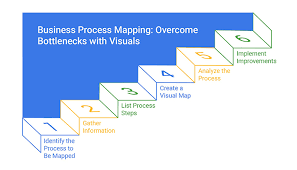
How to Start Process Mapping
Step 1: Choose One Important Process
Start small.
Pick one workflow that impacts revenue, customers, or operations.
Examples include:
- Customer onboarding
- Project delivery
- Billing
- Sales approvals
Step 2: Document Every Step
Write down everything.
Do not skip details.
Capture:
- Who performs the step
- What triggers it
- What happens next
Step 3: Measure Time
Track how long each step takes.
Many bottlenecks reveal themselves immediately.
Step 4: Identify Friction
Look for:
- Delays
- Duplicate work
- Confusion
- Rework
- Waiting periods
These are improvement opportunities.
Step 5: Simplify
Remove unnecessary steps.
Reduce handoffs.
Clarify ownership.
Keep the process easy to follow.
Common Mistakes to Avoid
Mapping Only the Ideal Process
Map reality.
Not the version everyone wishes existed.
Making It Too Complicated
Simple maps work best.
Focus on understanding flow.
Treating It as a One-Time Exercise
Processes evolve.
Review them regularly.
Update them when conditions change.
Ignoring Employee Feedback
Frontline employees often know where the friction lives.
Listen carefully.
They see problems leaders may miss.
Building a Culture of Continuous Improvement
The best organizations make process review a habit.
They do not wait for a crisis.
They regularly ask:
- Where are delays happening?
- What step no longer adds value?
- What can be simplified?
Small improvements compound.
One process improvement this month.
Another next month.
Over time, the results become significant.
Actionable Steps You Can Take This Week
- Select one workflow to map.
- Write every step on a whiteboard or document.
- Identify the longest delay.
- Find one duplicate task.
- Assign ownership for every step.
- Remove one unnecessary approval.
- Measure turnaround times.
- Ask employees where they experience friction.
- Test one improvement.
- Review results after two weeks.
Final Thoughts
Growth opportunities are often hiding inside daily operations.
They are buried beneath routines people no longer question.
Process mapping shines a light on those areas.
It exposes bottlenecks.
It reveals waste.
It creates clarity.
Most importantly, it uncovers opportunities that already exist inside the business.
Before adding headcount.
Before buying new tools.
Before chasing another growth initiative.
Map the process.
You may discover that your next breakthrough has been sitting inside your workflow all along.
