

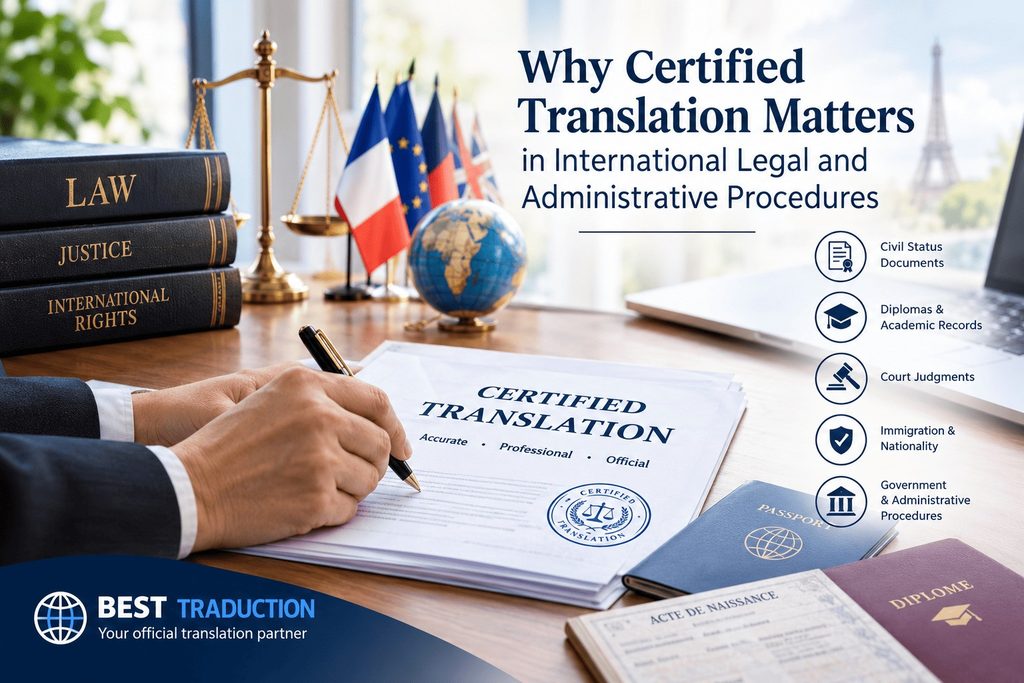
International mobility has made legal and administrative procedures increasingly cross-border. People move between countries for work, education, family reunification, business, immigration, and other reasons. As a result, courts, government agencies, universities, and other institutions frequently receive official documents written in languages different from their own.
In these situations, translation is more than simply converting words from one language into another. When a document is intended for an official procedure, the authority receiving it may require a certified or sworn translation prepared by a qualified professional.
What Is a Certified Translation?
A certified translation is a translation prepared and authenticated by a translator who has the appropriate status or authorization under the relevant country’s rules.
The exact requirements vary depending on the country, the institution, and the type of procedure involved. In France, for example, Service-Public explains that an approved translator is a judicial expert registered on a list maintained by a court of appeal. The Cour de cassation also provides an official directory for finding approved experts and translators.
This distinction is important because not every translation is automatically suitable for an official procedure.
A person may be able to translate a document accurately for personal understanding, but an immigration authority, court, university, or civil-status office may require a translation produced by an appropriately qualified translator.
Which Documents May Require Certified Translation?
The documents concerned depend on the procedure and the requirements of the receiving authority. Common examples include:
- Birth certificates
- Marriage certificates
- Divorce judgments
- Death certificates
- Criminal record certificates
- Court decisions
- Diplomas and academic transcripts
- Employment documents
- Driving licences
- Administrative certificates
- Corporate and commercial documents
Civil-status documents are particularly common in international administrative procedures. For example, French public authorities specify that foreign-language documents submitted in certain procedures may need to be accompanied by a translation prepared by an approved translator.
For nationality procedures, Service-Public also states that translations of foreign-language documents must meet specific requirements, including use of a translator registered with the relevant courts in France or, in certain circumstances, an appropriately authorized translator from another European country.
Why Accuracy Matters in Legal Documents
A legal document contains information that can have significant administrative or legal consequences. Names, dates, places of birth, identification numbers, legal terminology, and references to authorities must be reproduced carefully.
Even a seemingly minor error can create questions about the relationship between the original document and its translation.
For this reason, professional translators working with legal and administrative documents must pay attention not only to vocabulary but also to formatting, terminology, names, dates, seals, stamps, signatures, and other relevant elements of the original document.
The objective is not to rewrite the document or simplify its contents. It is to provide a faithful representation of the source document in the required language.
Certified Translation and International Procedures
Certified translations are frequently associated with international procedures because authorities need reliable documentation when the original document is written in another language.
For example, someone applying for a nationality procedure may need to submit foreign civil-status records. A student applying to an educational institution abroad may need translated diplomas or transcripts. A person involved in a legal proceeding may need a translation of a judgment or another official document.
The requirements can differ significantly from one country to another. Applicants should therefore check the instructions of the authority receiving the document before ordering a translation.
In France, official guidance specifically recommends checking the requirements applicable to the document and procedure. In some situations, certain multilingual public documents may not require a translation, while other documents may require one.
Translation Is Not the Same as Apostille or Legalization
Another common source of confusion is the difference between translation and document authentication.
A certified translation does not necessarily replace an apostille or legalization. These are separate formalities.
An apostille or legalization concerns the authenticity of certain elements of a public document, such as the signature or official seal, depending on the applicable rules. A translation, on the other hand, concerns the language of the document.
In some international procedures, an authority may require both an authenticated original document and a certified translation.
The exact order of these steps can also depend on the country involved. Applicants should therefore verify the requirements with the relevant authority, embassy, consulate, or administration before beginning the process.
Choosing a Professional Translation Service
When an official translation is required, choosing the appropriate translator is an important part of the process.
Before ordering, clients should verify:
- The translator’s qualifications or official status
- Whether the translator is authorized for the relevant language
- Whether the translation meets the requirements of the receiving authority
- Whether additional formalities such as apostille or legalization are required
- The required format and number of copies
- The deadline for submitting the documents
A professional translation service should also be transparent about what is included in the service and what may require additional formalities.
For people who need certified translations of official documents for international procedures, BEST TRADUCTION provides translation services for a range of administrative, academic, civil-status, and legal documents.
The Growing Importance of Professional Legal Translation
As international mobility continues to connect individuals, businesses, courts, universities, and public administrations across borders, accurate document translation remains an important part of international communication.
The role of a professional translator is not simply linguistic. Legal and administrative documents require attention to terminology, context, formal requirements, and the expectations of the institution receiving the document.
For individuals dealing with immigration, nationality, education, civil-status matters, or legal proceedings, understanding the distinction between a standard translation and a certified translation can help avoid unnecessary delays.
Ultimately, the correct translation is the one that satisfies the requirements of the authority receiving the document. Those requirements should always be checked before the translation is ordered, particularly when the procedure involves more than one country.
