

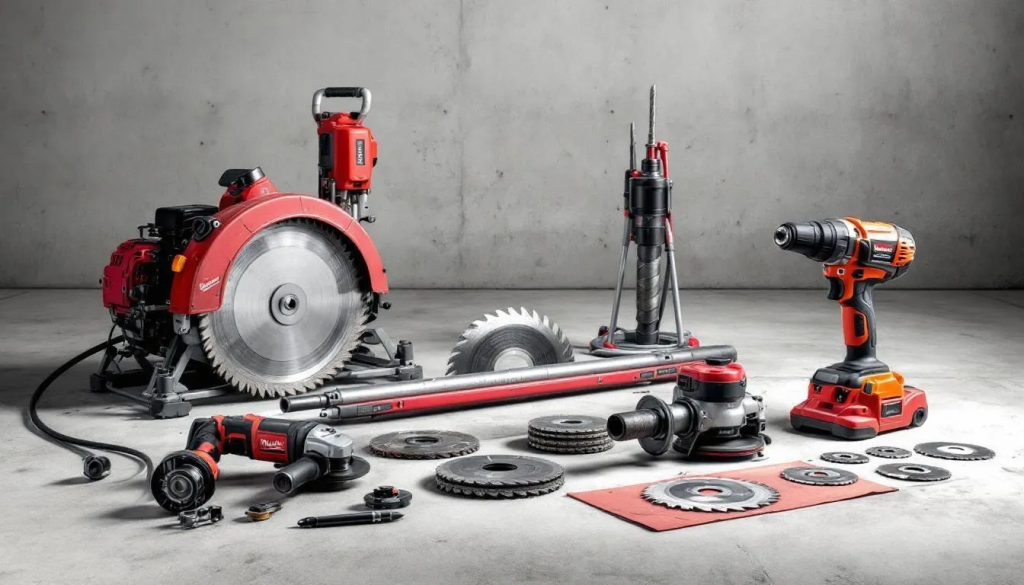
The durability of concrete gives it its reputation. This reputation is well-deserved since cured concrete is, in fact, one of the most durable construction materials available. It can withstand decades of exposure to traffic loads, natural elements, vibration, and loads. The very properties which give concrete its value also make concrete extremely hard to cut.
Watching how a concrete slab is cut open for utilities powered by generators, road repairs, joint openings, or demolition will show that good results depend not on using enough force, but on choosing the proper tools for each particular situation. This guide takes you through that process.
Knowing Exactly What Is Being Cut
Concrete is not always “concrete” alone. Modern mixes include granite, limestone, basalt, recycled aggregates, steel reinforcement, fiber reinforcement, fly ash, silica fume, and other chemical additives. All of these have an impact on cutting performance.
Dense aggregates increase blade wear. Steel reinforcement makes cutting much harder. Old concrete becomes stronger as a result of hydration and mineral growth. Skilled operators devote a lot of time to analysis of the material before actual cutting. Choosing the most appropriate equipment for the job is always the most expensive thing one can do.
Why Power Supply Matters More Than Many Realise
Before getting into the topic of saws and blades, one should take a look at the machine that drives all of this. A generator is a must-have piece of equipment for large-scale cutting work because there is always a lack of electricity supply on site, especially for road rehabilitation, bridge maintenance operations, airport work and other construction activities done in distant places.
The quality of electrical voltage has a direct impact on the efficiency of the whole cutting process. Voltage instability may affect performance, cause inconsistencies in cutting speed, and fast degradation of key machine elements. It is an underestimated aspect of concrete cutting by beginners, but experienced professionals know that unstable power sources can ruin even the best cutting equipment.
Elevated Concrete Cutting- the Emerging Tendency
It is obvious that concrete cutting is primarily related to road surfaces and floors. However, nowadays, there is an increasing number of concrete cutting operations performed at elevation.
In the course of many contemporary construction works, the need emerges for suspended slabs, bridge decks, parking structures, retaining walls, and various other elevated constructions. The ability to get to such constructions presupposes having special equipment.
A properly positioned boom lift will help the operator reach hard-to-reach places and at the same time maintain balance and visibility. Bridge maintenance specialists frequently use such equipment in the process of removing decaying concrete around bridge supports and expansion joints.
The right choice of equipment influences not only the efficiency of work, but also its accuracy. While performing work with reinforced concrete, it is necessary to align the blade while working. In this case, proper access allows the operator to perform this task.
Therefore, the boom lift for sale becomes increasingly popular along with the development of the concrete cutting industry.
Diamond Technology Changed Everything
The history of concrete cutting can be roughly split into two parts: before the invention of diamond blades and after the invention of diamond blades. Diamond technology revolutionized an industry that previously used slow and destructive techniques.
Modern cutting systems employ industrial diamonds embedded into specially engineered metal bonds. Controlled wear of the blade reveals new particles of diamonds, ensuring constant cutting efficiency. The composition of the bond plays an enormous role. Hard concrete usually requires soft bonds with aggressive diamond exposure. Soft materials require hard bond formulations which allow holding diamonds longer. Wrong choice of the bond dramatically reduces the lifetime of the blade regardless of its quality.
Where the Concrete Disc Cutter Excels
Concrete disc cutters are some of the most versatile machines in current use. In contrast to large walk-behind saws, which are mainly used for cutting in a horizontal position, a concrete disc cutter allows flexibility in operation and is able to handle a variety of uses. They include wall openings, curb modification, opening for utilities, trenching, repairs, and demolitions.
Current disc cutters have combined compact design and the capability of cutting at great depths, which allows conducting very precise cutting in confined areas. This is achieved thanks to the combination of mobility and strength of the machine. A person performing operations in an industrial plant can navigate a disc cutter in narrow spots where no other machinery would fit. On top of that, advanced blades can deal with highly reinforced concrete rather effectively.
It is important to realize that speed of cutting does not always determine efficiency.
Wet Cutting Versus Dry Cutting
Among the many decisions made during operations, water choice comes first. Wet cutting is still the preferred technique since water helps to cool the blade, keeps away dust particles in the air, and improves efficiency in the process of cutting. Continual cleaning of the cutting area by water prevents overheating of the blade.
Dry cutting is advantageous since it allows for greater mobility. In cases where water management poses logistical problems, dry cutting is a better option. Every choice has its own operational implications. Construction firms working on active roads prefer wet cutting due to the need to manage the dust.
When water use is restricted, a special dust extraction system is used in interior renovation projects. It all depends on the environment, regulations, and the project requirements.
Equipment Costing Issues
Costs associated with operation and maintenance of equipment tend to be underestimated by contractors. The consumption rate of blades, fuel consumption, maintenance schedule, efficiency of labour, downtime, and duration of the job usually play an important role in profitability more than initial costs. Experienced contractors consider generators for sale and boom lifts for sale when forming the fleet of their equipment that will be able to perform in the field conditions, because it makes all the difference in cost.
This is the reason why most people take much time considering the concrete disc cutter cost. The machine that consumes blades quickly or requires regular maintenance will eventually turn out to be quite costly in the course of operation. Fleet managers have started making their purchasing decisions based on the total cost of ownership using performance data collected in different projects.
Conclusion
When the proper combination of equipment, blade, power, and access devices is brought together, everything seems simple. Yet behind this simplicity is a series of engineering choices that turn one of the most difficult materials in the construction industry into an extremely precise product, including financial considerations such as concrete disc cutter cost, especially when carrying out a comparative analysis of different brands, sizes, and synthesis with your site.
