

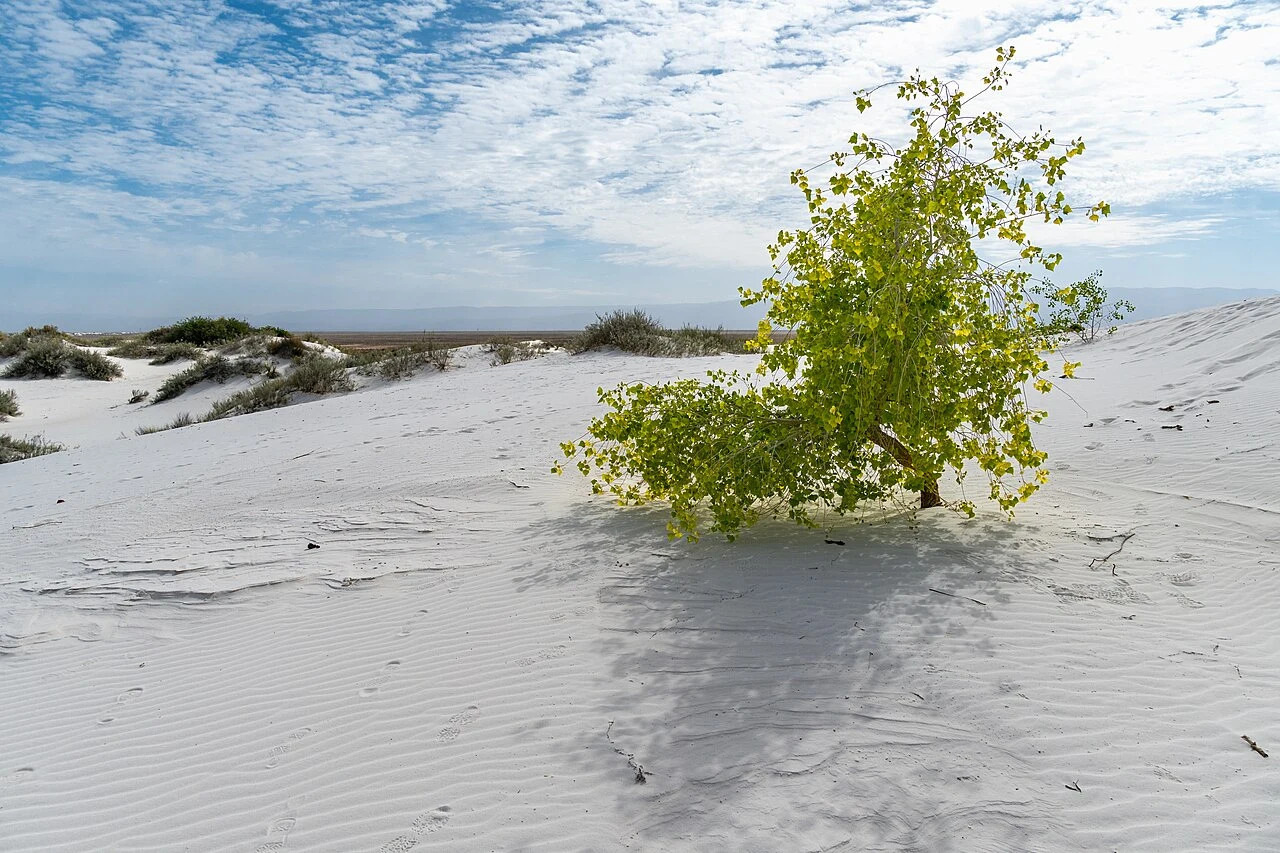
The sediments beneath White Sands hold an uncomfortable lesson about speed. Research published in Science Advances finds that people living around Lake Otero during the Last Glacial Maximum experienced abrupt environmental changes — shifts in water, vegetation and climate that unfolded fast enough to reshape a single lifetime. The finding matters beyond archaeology, because the debate about modern climate change is, at its core, also a debate about speed: not only how much conditions change, but how quickly societies must adjust.
White Sands, now a national park in New Mexico, is famous for human footprints preserved in the ancient lake bed, as the National Park Service outlines. The new work connects those human traces to a restless environment — and in doing so, gives the deep past a direct line into the present. Keep up with our coverage in the news archive.
Change that arrived within a lifetime
Climate history is often told in slow motion: ice sheets creeping, seas rising over millennia. The White Sands record tells a different story in places. Lake levels swung, shorelines migrated, and the mix of plants and animals around the basin shifted in abrupt steps. For the families living there, the practical consequences were immediate — hunting grounds moved, water sources appeared or failed, and knowledge gathered over decades could depreciate within years.
That distinction — between gradual drift and abrupt change — is the one modern planners wrestle with. A slow trend can be budgeted for. A sudden shift, in rainfall, heat or water supply, stresses systems built on the assumption that next year will resemble the last. White Sands shows that assumption failing, naturally and repeatedly, long before industrial emissions entered the story.
Adaptation was the daily work
The people of the lake did not control the climate, but they were not helpless before it. Their toolkit was behavioural: move camp when the shore moved, broaden the diet when favoured foods failed, maintain networks of relationships across a wide region so that local failure was not final. The footprints — mixed groups of adults and children ranging far across the flats — are the visible residue of that flexibility.
It is worth noting what adaptation cost. It cost effort, knowledge and constant attention. Nothing about it was automatic, and presumably it did not always succeed. The record preserves a community that coped; it cannot tell us how many hard seasons were involved, or what was lost along the way. Honest readings of the past resist turning adaptation into a comfort story.
What the parallel can — and cannot — say
There are limits to the comparison. Ice Age swings at White Sands were driven by natural forces, and the communities affected were small, mobile and lightly equipped by modern standards. Today’s change is human-driven, global, and bearing down on fixed cities, farms and infrastructure that cannot simply walk to a new shoreline. In that sense the modern problem is harder, not easier.
But the core insight survives the differences: the rate of change is itself a hazard. Systems — ecological or social — are stressed less by the destination than by the speed of travel. White Sands’ sediments demonstrate that abrupt shifts are part of how the Earth’s climate behaves, and that the societies which fare best are those organised to notice change early and respond without waiting for stability to return.
A record written in mud and gypsum
When Lake Otero finally dried, it left behind the gypsum that forms today’s white dunes — and, sealed in its bed, the footprints of the people who had adapted to its moods. The landscape is now a protected monument to both: a climate archive and a human one, in the same ground.
For readers in a century again preoccupied with abrupt change, White Sands offers neither prediction nor consolation. It offers evidence — that change can come quickly, that ordinary people meet it with ordinary ingenuity, and that flexibility, practised daily, is the oldest climate policy there is.
More reporting on science and society is on our homepage.
