

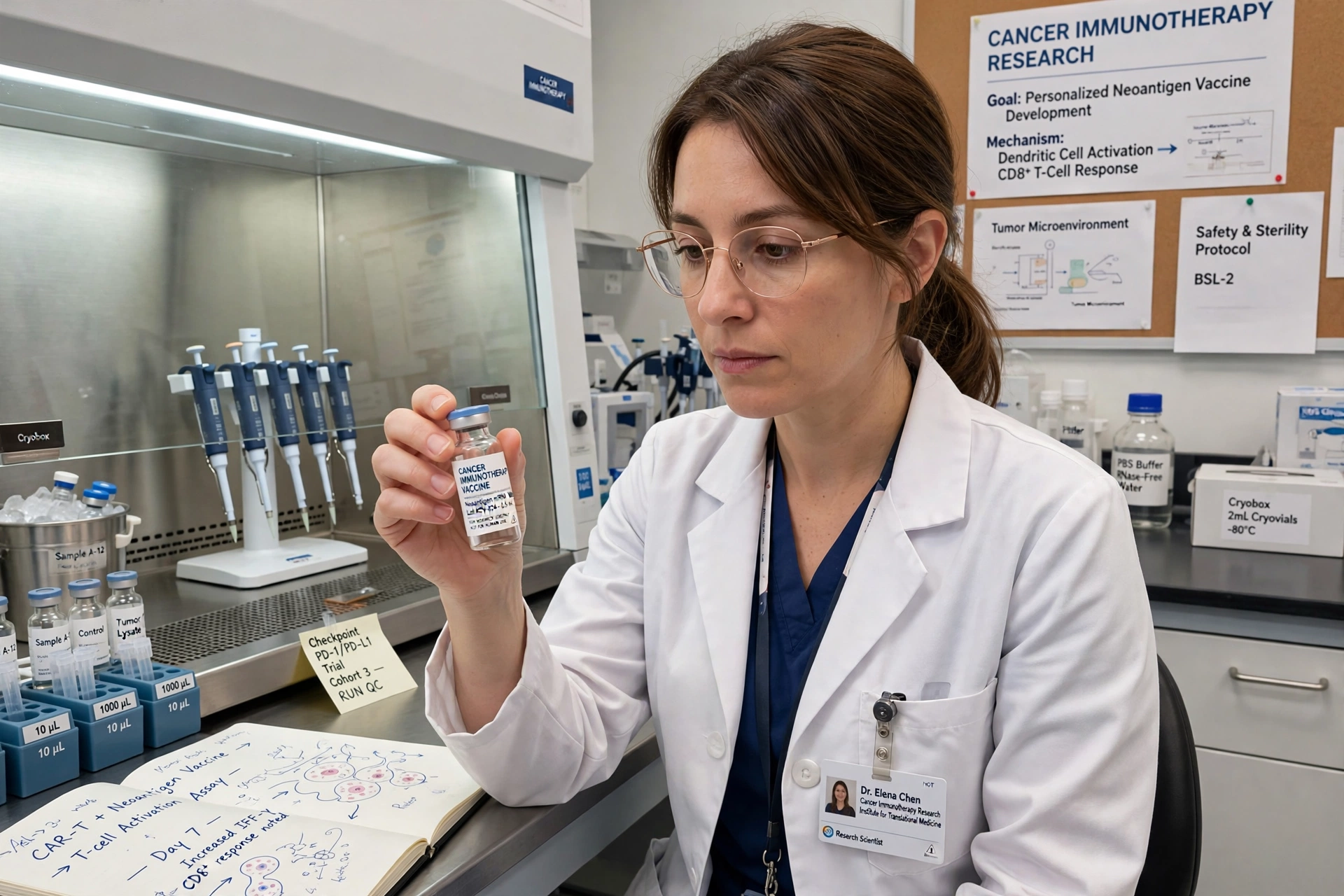
This report applies a simple evidentiary standard to a widely shared health story. A phase 1 trial in Nature Medicine evaluated NeoVax, a personalised neoantigen vaccine derived from each patient’s own tumour mutations, combined with nivolumab in platinum-sensitive recurrent ovarian cancer. The findings on record are that bespoke vaccines could be manufactured and given, that safety was acceptable in this small group, and that T-cell responses were observed. For dailynewslaw.com readers, this article distinguishes those findings from the efficacy claims the trial cannot support, because in medicine, as in law, the strength of a conclusion may not exceed the strength of its evidence.
Read the Finding, Not the Hype
In health reporting, as in law, the exact wording of a finding controls what may responsibly be concluded from it. A phase 1 trial published in Nature Medicine tested NeoVax, a personalised neoantigen vaccine made from each patient’s own tumour mutations, combined with nivolumab, a PD-1 checkpoint inhibitor, in platinum-sensitive recurrent ovarian cancer. Its findings were specific: vaccines could be manufactured and administered; safety was acceptable; and T-cell immune responses were observed. The trial did not find, and was not designed to prove, that the treatment cures cancer or improves survival. Readers familiar with our fact-check of health care claims will recognise the discipline required: report what the record shows, and identify plainly what it does not.
Feasibility: The Question This Trial Was Built to Answer
A personalised vaccine poses an obvious practical challenge. Tumour material must be analysed, mutation-derived neoantigen targets selected, a vaccine manufactured for one individual, and treatment delivered alongside nivolumab. The trial demonstrated that this sequence could be completed for patients in the study. That is the meaning of feasibility here, and it is a substantive result for a complex intervention. Safety being acceptable adds a second, equally bounded conclusion: in this small, monitored population, the combination’s effects did not bar further research. Neither conclusion licenses claims about effectiveness. Any future claim of benefit would need to be proven in larger trials designed for clinical outcomes, with appropriate comparisons.
The Immune Evidence and Its Limits
Evidence of T-cell responses is the trial’s biological exhibit. It indicates that immune cells responded in ways consistent with recognising the vaccine’s neoantigen targets, a necessary step if personalised vaccination is to work at all. But a marker of immune activity is not a verdict on clinical benefit. Tumours may or may not respond; recurrence and survival were not established by this early study. The National Institutes of Health explains in its research resources why early signals require confirmation in larger populations. Treating a phase 1 immune signal as proof of a working treatment would be the scientific equivalent of treating an allegation as a judgment: the process exists precisely to prevent that error.
Context: A Serious Disease, a Small Study
Participants had ovarian cancer that had recurred but remained platinum-sensitive, a serious situation following earlier chemotherapy. Small early trials in such populations are valuable for testing whether an approach can be delivered safely, yet their size limits generalisation. Individual tumours vary, prior treatments vary, and a handful of carefully selected participants cannot represent everyone with the disease. The study, reported in Nature Medicine, should therefore be cited for what it is: a feasibility and safety study with encouraging immune observations, conducted in a defined group, whose results now require testing at greater scale before clinical meaning can be assigned with confidence.
Conclusion on the Current Record
On the current record, the defensible statement is short. NeoVax could be made from patients’ own tumour mutations and given with nivolumab in a phase 1 trial; safety was acceptable; T-cell responses were seen; larger studies are needed. That is the whole finding, and it is still worth reporting, because personalised cancer vaccination is a demanding idea that has now passed an early practical test. Our coverage of stalled legislation such as the CLARITY Act shows how often an early stage is mistaken for a final outcome. Here, too, the stage matters. Early, feasible and safe enough to study further: no more, and honestly, no less.
One More Point of Context
From an evidentiary standpoint, the trial’s contribution is best understood as establishing that the proposed procedure can be carried out and studied further, not as a ruling on its value. That distinction protects everyone involved: patients are not given false certainty, researchers are not burdened with claims they did not make, and readers are not misled about how close a personalised vaccine may be to routine care. Future trials, with larger numbers and clinical endpoints, are the forum in which any claim of benefit will properly be tested and either sustained or rejected.
