

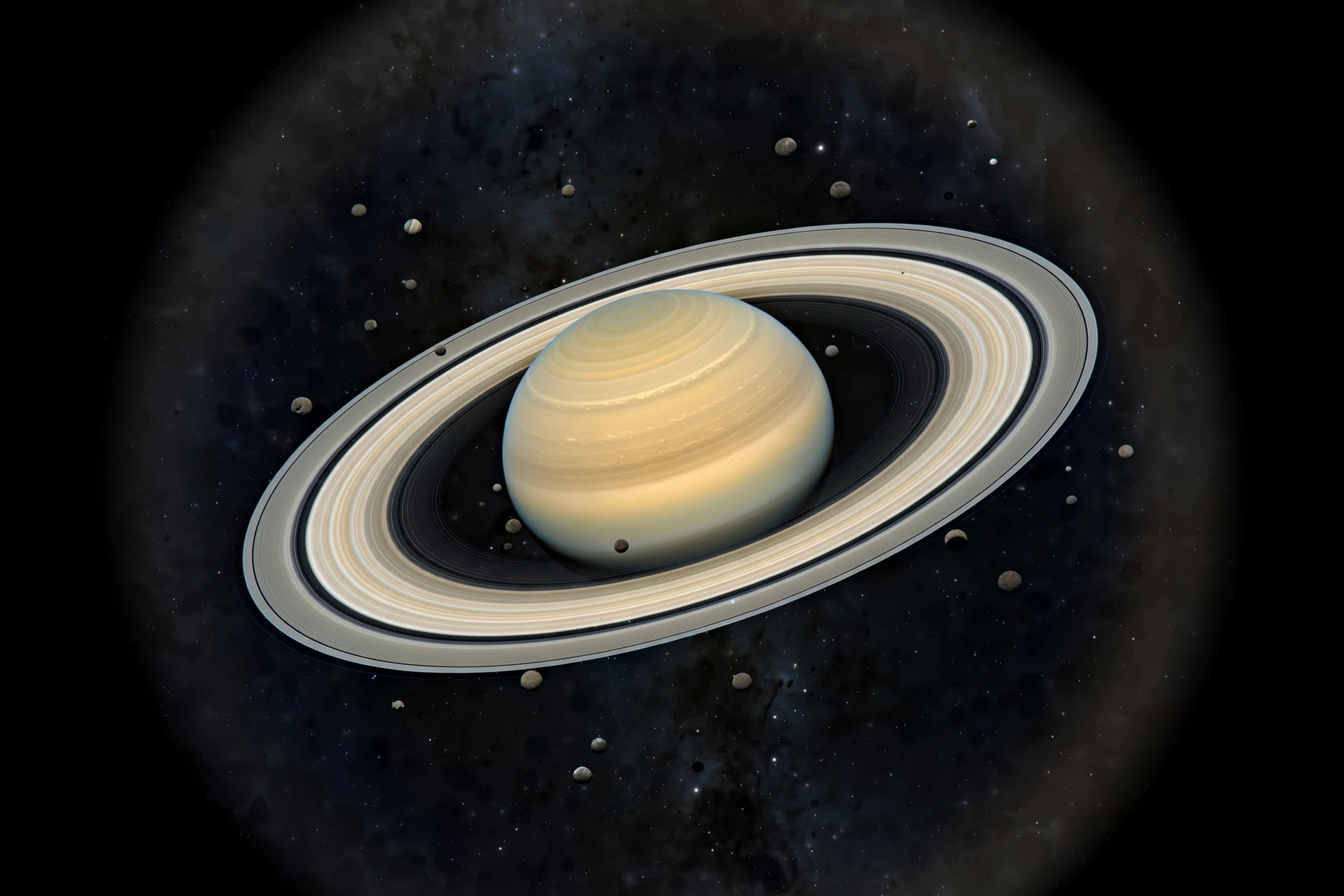
The evidence is in, and it supports a remarkable conclusion: Saturn has 274 moons. Astronomers have confirmed 128 new objects, lifting the total from 146 to a figure greater than all other planets’ moons combined. This dailynewslaw.com report examines the case methodically: the telescope survey behind the claim, the image technique used to find such faint bodies, the independent recognition that settled their status, and the orbital evidence pointing to captured worlds broken apart by collisions long ago.
The Case for 274, Presented Clearly
Treat this discovery as a case built on evidence. Astronomers have confirmed 128 new moons of Saturn, raising its total from 146 to 274, more than all other planets combined. The claim rests on years of observations with the Canada-France-Hawaii Telescope on Mauna Kea, orbital analysis involving Dr Edward Ashton and colleagues at the University of British Columbia, and formal recognition by the International Astronomical Union. Each element matters. Without repeat observations there is no reliable orbit; without a reliable orbit there is no confirmation. Readers of our fact-checking work, including this health care claims explainer, know that a strong headline is only as good as the record underneath it.
Exhibit A: A Technique Built for Faint Evidence
The method, called shift and stack, works like careful document review. Deep images gathered over several years were shifted to align with the expected movement of a distant moon, then stacked. True moons accumulated light and appeared; stars and noise did not align in the same way. Candidates were then tracked until their paths around Saturn were established beyond reasonable doubt. The Canada-France-Hawaii Telescope supplied the raw evidence, but the verdict came from persistence. Brief sightings were never treated as proof, which is precisely why the final announcement carries weight with astronomers who were not part of the survey team.
Character Witnesses: Orbits That Reveal Origins
What the new moons are like helps explain where they came from. They are small, a few kilometres across, distant, and set on tilted orbits, many of them retrograde. Large moons that formed beside Saturn follow far more regular paths. Irregular moons, by contrast, look captured, and their clustering suggests some are fragments of bigger captured bodies destroyed in collisions. That interpretation, advanced by researchers at the University of British Columbia, turns each fragment into testimony about an older, more crowded solar system. The moons do not merely add to a total; they describe a history of capture, impact and survival around a giant planet.
Precedent: How Moon Counts Have Changed Before
Saturn and Jupiter have traded the lead before as instruments improved, which is a useful precedent for understanding this jump. Jupiter currently has 95 confirmed moons, so the new gap of 179 is historically large. Earlier changes were smaller because telescopes could only reach brighter objects. This survey deliberately pushed fainter, using stacked images to recover signals no single exposure could show. Our coverage of the CLARITY Act’s stalled progress illustrates how an official status can lag behind underlying activity; astronomy has the same pattern. The moons existed long before recognition. What changed was the quality and completeness of the evidence supporting their status.
Judgment: Confirmed, With Further Review Expected
The proper conclusion is narrow and firm: 274 is the confirmed total today, recognised through the field’s established authority, and supported by published orbital work. It is not a claim that the census is complete. Astronomers expect refinements, designations and possibly further discoveries as surveys continue to probe fainter limits. Nor does the finding alter anything about Saturn’s familiar features; the rings and large moons remain as they were. What changes is the documented scale of the system around them. For a daily news audience, that is the takeaway: a record established by evidence, open to revision only by better evidence, and remarkable on its own terms.
One More Point of Context
Historians of astronomy will place this result beside earlier leaps that followed new instruments, from the first telescopic moons to photographic surveys of the outer planets. The pattern is consistent: each generation assumes its census is nearly complete, and each better tool proves otherwise. Saturn’s distant irregular population was the natural place for such a surprise, because it is faint, spread over a huge volume of space, and mixed with fragments whose orbits only make sense when enough examples are available to compare side by side.
